Thursday, 3 November 2016

Twitter

We're now on Twitter
We'll use the twitter feed to keep you updated about what's happening on the course including;

  • Course closure
  • Course conditions such as hard frost
  • Work such as top dressing or aeration
  • Anything unusual or notable
Follow us on the following link

https://twitter.com/Greens_AGC

Aeration

The first aeration of the greens this winter has just been completed, we used our Verti-drain which can penetrate up to 30cm into the soil.  We usually alternate between deep aeration with the Verti-drain and shallower but more closely spaced tining.  Aeration helps us maintain a healthy well drained soil with deep rooted fine grasses.  It is essential for the production of high quality playing surfaces all year round.

Verti-draining the 12th green

STRI visit

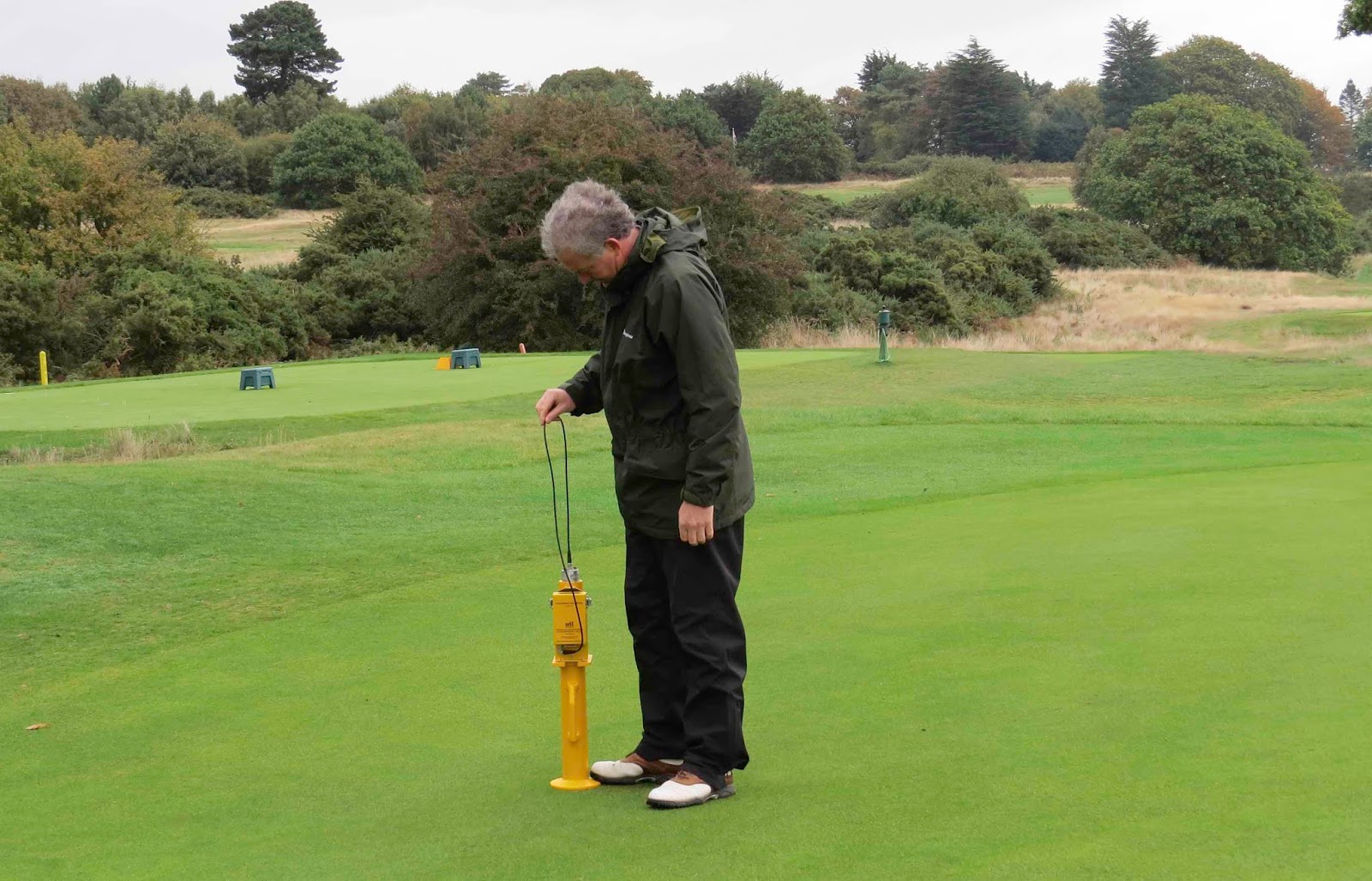
On the 18th of October we had our annual visit from Alistair Beggs our STRI agronomist.  We looked at many areas of the course but the emphasis is on greens.  Alistair brings some sophisticated tools so that we can objectively measure various aspects of green performance.  As usual our greens performed very well on smoothness, trueness and firmness.  Other factors affecting green performance, such as soil moisture and organic matter percentages at various depths in the soil profile are also measured.  The STRI now has a very extensive database of results from hundreds of golf courses all over the country and abroad and this data enables us to make objective comparisons of our performance.  The report is viewable on the members area of the website and there's a copy in the clubhouse.

Antony and Danny measuring green speed (It was windy so we were using the plastic tunnel for accuracy)

Nigel Robson measuring the firmness of the greens using a Clegg hammer

Alistair measuring trueness and smoothness 

Weather summary for October

Temperatures were close to average  at 11.8° with a high of 18.4° on the 3rd and a low of 5.4° on the 31st.  There was 57.6mm of rain, which is just above average, most of the rain fell early in the month and there was no rain after the 21st.

Heather management

We've cut the area of heather on the 13th carry.  This rejuvenates the heather and prevents it from becoming leggy.  It also provides us with seed rich brashings, that we can spread on other areas of the course.


Cutting the heather and collecting the brash and seed

Danny spreading brashings on the 12th carry

Renovation of green surrounds

Following on from treatment of the green surrounds to remove coarse grass, we've been renovating these areas to introduce fescue and bentgrass seed.  All of the surrounds were hollow cored and this was followed by overseeding and top dressing.  The seed has just started to come through so some of the areas with least grass cover will be hooped off to enable the seed to thrive.

Shane hollow coring

Danny, Neil and Antony collecting the cores
These were used for renovating pathways

Saturday, 8 October 2016

Weather summary for September

Another warm and dry month, making three on the trot.  July was the warmest we've recorded, August matched the previous high and so did September.  All three months had well below average rainfall and the September total was 28mm, well short of the 43.3mm average for the month.  Of the 28mm total, 22mm fell in one go on the 16th and 17th so a lot of this would have been lost to drainage and run off.  The average temperature was 17.9°, equaling the previous high for September recorded in 2006.  The highest temperature recorded was 26.3° on the 13th and the lowest 4.6° on the 26th

Friday, 7 October 2016

October course news

In early September we over-seeded the greens with high quality cultivars of fescue and bent grass.  Our aim is to increase the percentage of these grasses in our greens as they are capable of producing a much finer and denser putting surface than older cultivars.  The new 3rd green on the river course is a good example of what we’re striving for, as it was constructed with 100% fescue turf.  After over-seeding the greens required regular irrigation to enable the seed to germinate and to keep the new seedlings alive.  As a consequence of increased irrigation and other work such as top dressing to restore surface levels after the over-seeding the greens were much slower for the first couple of weeks of September and this dropped the average for the month to 8ft 1in - quite a contrast with the 10ft 9in average for August.  Once the new seed established, irrigation was stopped and the green speed increased to 9ft as they dried out.  Todays speed (6th Oct) is 9ft 8in and as it’s windy we’ve used a plastic tunnel to get more accurate readings.  Wind has a net slowing effect on stimpmeter readings even though the reading is an average of two rolls in opposite directions.  This was well illustrated today as on the exposed 14th there was a 10in difference in the speed with and without wind protection but on the sheltered 18th there was no difference.

A selective weed-killer (Rescue) that knocks out coarse Ryegrass and Yorkshire Fog in turf was applied to the immediate green surrounds and a few metres of the approach to the greens.  Coarse grass in these areas has been a long standing issue and we’re committed to improving this area of weakness.  The impact on the coarse grasses has been good and although many areas look patchy at present, they have been over-seeded and new finer grasses should fill in the gaps.  Getting  rid of the coarse grass completely will probably take several years but in subsequent years the impact will not be as great as for this first application. 

We’ve also undertaken another trial of using Rescue on the main course greens.  Theoretically this should be an excellent product for us, enabling us to bring about significant improvements to the greens by removing the coarser grasses.  Unfortunately, in practice things are a little more difficult.  Rescue can also have a strong negative impact on Highland bent, an old grass cultivar that makes up a significant percentage of our greens.  Although our greens would be improved in the long term by replacing Highland bent with modern cultivars the negative impact on the greens by removing it in one go would be considerable.  For this trial we’ve given the greens a little more fertiliser and water than normal, as other golf clubs have found that this reduces the impact on Highland.  It’s too early to tell how successful this has been but the early signs are good.

Course maintenance highlights during September
o   The greens over-seeding was very successful with very obvious lines of new seedlings coming through.
o   The first couple of weeks after seeding were very dry so regular irrigation was needed to encourage germination and keep the new seedlings alive.
o   The greens were top dressed twice, first immediately after seeding and then two weeks later
o   Topping up bunkers with sand continued
o   Rescue was sprayed on green surrounds and approaches to remove coarse grass
o   Rescue was applied to the river course greens, the 7th green on the main course and parts of the 8th and 11th greens.
o   Bracken spraying with Asulox continued
o   Gorse and bramble in the rough was sprayed with selective weed-killer.

Work programme for October
Renovation work to the areas of green surrounds and approaches treated with Rescue will include hollow coring, over-seeding and top dressing towards the end of the month.  Selective weed killer will be applied to some of the fairways, and work will continue on spraying encroaching gorse and bramble.
The final top dressing of the greens this year is scheduled for the week beginning the 24th October.
The programme of regular aeration work will start and this will continue throughout the winter and spring.  This aeration using deep tines alternating with shallower but more closely spaced tines is vital to combat the compaction caused by players and machinery. 

Our winter work programme will commence at the end of the month.  This winter rebuilding the 1st and 8th tees and levelling the 6th tee are the main priorities, together with the replacement of sprinklers on 2 or 3 holes.  We are also extending the irrigation system on the 2nd and 14th fairways to reflect the current playing lines and alongside the putting green/club house to improve conditions in this heavily trafficked area. 

STRI Inspection

The Clubs agronomist are due to carry out their annual visit to the course on 18th October.  This provides us with excellent impartial feedback on the condition of the course versus their huge database of courses across the UK including the Open Championship venues.  They also provide invaluable advice in connection with the ongoing maintenance and improvement regimes.  Their report will be available in the Club House and on the web site in due course.

Thursday, 22 September 2016

Renovation work

It's three weeks since we over-seeded the greens and the results have been spectacularly good.  Lines of fine fescue seedlings are clearly visible on all of the greens particularly when the sun is low in the mornings and evenings.  For the first two weeks after seeding we kept the moisture level in the greens a little higher than our usual target to enable the new seedlings to germinate and get established.  The higher moisture level combined with high temperatures resulted in lush grass growth and slower greens over this period.  Now that the seed is well established we can dry the greens out a little more but we still need to provide enough moisture to support the new seedlings.  We also applied Rescue to the first three or four metres of approach and the collars of the greens, to kill off the coarse ryegrass in these areas.  This has also worked well and we've been putting in lots of seed to replace the rye with the over-seeder and by hand where required. Getting rid of the ryegrass completely will probably take a few years of repeat applications but subsequent applications will not have as dramatic an impact as the first.  We're also trialling rescue on some of the main course greens but it's too early to assess the results.  The 7th green has been sprayed, the front part of the 8th and the left side of the 11th, the treated areas look quite pale at present but the colour should come back over the next couple of weeks.

Fescue seed coming through on a green surround
Lines of seed coming through on an area of green treated with Rescue
Creating slots for the seed mix
Spreading top dressing mixed with seed
The 11th green with the Rescue treated area on the right

Late summer wildlife

There's a lot of wildlife around the course at present, the ivy bushes are literally buzzing with insect life on sunny afternoons, with large numbers of butterflies, bees and hoverflies taking advantage of this late season nectar source.  Reptiles are enjoying the warm weather and can be seen basking in sunny spots sheltered from any breeze.

There are at least 11 butterflies in this photo, mainly red admirals but there's a peacock and a couple of small coppers too

An adder on the right and grass snake on the left, the first time I've seen them together
Another adder, this one a little larger, in the afternoon sun