Wednesday, 10 August 2016
Green speed - 13ft 4in
After a couple of wet summers we've recently had the first opportunity for a while to dry the greens out properly. We do this to stress out some of the weed grasses but also because our greens perform at their best when they are dry. The breezy spell over the last few days meant that no dew formed overnight and the greens started the day dry. This resulted in the green speed reaching 13ft 4in on Tuesday.at a cutting height of 5mm. Whilst greens of this speed have some novelty value and some players enjoyed them immensely, others found them far too difficult. It's worth noting that we never actively manage the greens to get the speed into this range, the speed comes as a result of a combination of grass species composition and very dry conditions. For the first 10 days of August green speeds have averaged just over 11ft. Anything much above 11ft severely limits pin placement options on our undulating greens and 13ft probably represents the upper limit for playability. Irrigation overnight has settled the greens down to a much more manageable and sensible speed of just over 10ft.

Friday, 5 August 2016
Weather summary for July
July was one degree warmer than our long term average at 18.0°. The lowest temperature was 9.8° on the 14th and the highest 28.0° on the 17th. The rainfall total was 27.4mm, well below the average of 46.3mm. Although the rainfall figure was low, what rain we had was nicely spaced through the month so hardly any irrigation was needed. This has been the pattern throughout the spring and early summer so we still haven't irrigated the fairways at all this year.
August course news
A
relatively dry July enabled us to stress out the meadow grass in the greens a
little and tilt the balance in favour of the fine grasses. The fescue in the greens is doing
particularly well, filling in the gaps vacated by the meadow grass. We’ve been over-seeding the greens with the
best cultivars of fine grasses for several years and although progress is slow,
this is to be expected when sowing seed into established turf that already has
a good botanical composition. Green
speeds were generally between 9ft and 10ft with an average of 9ft 2in. This average would have been considerably
higher without a low reading of 8ft 2in taken when the greens had not been cut
after top dressing. Warm wet weather
towards the end of the month has seen strong grass growth which reduces green
speed a little but we’ve compensated for that by increasing use of the
roller. Regular use of the growth
regulating product Primo Maxx is also helping us to maintain slightly higher
green speeds without resorting to the seemingly obvious but risky and not
particularly effective option of reducing the height of cut.
Course
maintenance highlights during July
·
Greens
top dressed on the 18th
·
Fertiliser
applied to greens during the last week of the month and to tees on the 1st
of August. This will be the last nitrogen
fertiliser applied this year
·
Wetting
agent, seaweed extract and iron applied to the greens (Wetting agent is a
surfactant that enables us to manage soil water so that greens dry out evenly
and we minimise water use.)
·
Minimal
greens irrigation was needed despite the low rainfall because the rain was
nicely spaced through the month.
·
Verti-cutting
greens to remove lateral growth. We can
only do this work during periods of strong grass growth as it is an aggressive
operation which adversely affects the finer grasses if they are not growing
strongly.
·
Mowing
the denser areas of rough and removing the clippings, particularly where
players are unable to reach the fairway off the tee.
·
Mowing
and removing clippings from fairway bunker banks where the grass has grown too
dense.
·
Selective
weed killer was applied to tees and some areas of semi rough including bunker
banks.
·
Ragwort
pulling
·
Bracken
control has started and will continue over the next few weeks
Work
programme for August
Whilst
the current strong grass growth continues we will carry out frequent
verti-cutting of the greens to help remove some of the coarser grass and refine
the putting surfaces. More verti-cutting
will also be done on the approaches.
Later
in the month we will apply Rescue, a product that selectively kills ryegrass
and other coarse grasses in turf to the approaches. Following a successful trial on the 17th
last year all the approaches will be sprayed this year. The areas will be over-seeded first to help
fill in the gaps left as the ryegrass dyes back. After treatment the areas will thin out for a
while but they should recover after a few weeks.
We
also intend to trial Rescue again on some areas of main course greens. The product has worked well on the river
course greens but when we tried it on the 7th green on the main
course in 2012 it adversely affected that green. For this trial we will be applying the
product earlier in the season and adjusting our greens maintenance programme to
minimise turf stress prior to spraying. Despite
the previous adverse reaction on the 7th we believe trialling the
product again is appropriate due to the significant benefits that it brings in
terms of removing coarse grasses and improving green quality.
Greens
over-seeding is scheduled to start on Wednesday the 31st of
August. Over-seeding will be followed by
top dressing and the work should be completed in two or three days. We require dry conditions for this work so if
we are delayed by adverse weather the work may run into the following week.
Saturday, 23 July 2016
Sheep grazing
154 sheep (North Country Mules) were delivered to our stewardship grassland yesterday. The fields have been grazed since 2013 and are managed to comply with our higher level and entry level stewardship agreements. The aim is to develop species rich dry acid grassland and there is already a marked increase in the number of wild flowers present and and a larger percentage of fine grasses.
The grassland is situated to the north of the main course beyond the woodland.
The grassland is situated to the north of the main course beyond the woodland.
 |
| Some of the 154 North Country Mules delivered yesterday |
Tuesday, 19 July 2016
Wildlife on the course
There's lots to see on the course at present, with many species of wild flowers putting on a show and the warm weather bringing out the butterflies and dragonflies. We had some Egyptian geese on the river course last week and our first Pyramidal orchid.
 |
| Egyptian geese on the 3rd green on the river course |
 |
| Pyramidal orchid on the river course |
 |
| Gatekeeper |
 |
| Small skipper (the very similar Essex skipper is also present) |
 |
| Blue tailed damselfly |
 |
| Ruddy darter |
Tuesday, 5 July 2016
Weather summary for June
The temperature was very close to average for June at 15.1° for the month with a low of 9.8° on the 10th and a high of 22.6° on the 4th. These were the lowest high and highest low for June since we installed the weather station in 2000 so the temperature range was tiny. We had 62.8mm of rainfall which is well over the 43.7mm average for the month. For the first 10 days we had hardly any rain and then four days with over 10mm spread through the rest of the month.
Friday, 24 June 2016
Greens work
This week we've aerated the greens with our new Toro tractor mounted aerator and this was followed by over-seeding and top dressing. The new machine does an excellent job and causes minimal disturbance to the green surface. The top dressing has gone in very well - helped by subsequent heavy rain and the current spurt in grass growth. Fertiliser was applied to the greens a couple of weeks ago and the growth resulting from this will be at its peak for the next week or so.
 |
| The new aeration machine |
 |
| The aeration holes after one pass with a greens mower |
 |
| Top dressing |
 |
| Brushing in |
Bunker banks
Dense rough has developed on some of the bunker banks and we're working our way round cutting those that are getting rather too penal. As with the wider rough it is our aim to have wispy, natural looking but playable rough on the fairway bunker banks. When it gets too long and heavy we cut and collect the clippings to remove nutrients which helps us to develop thinner rough for the future.
 |
| Before mowing |
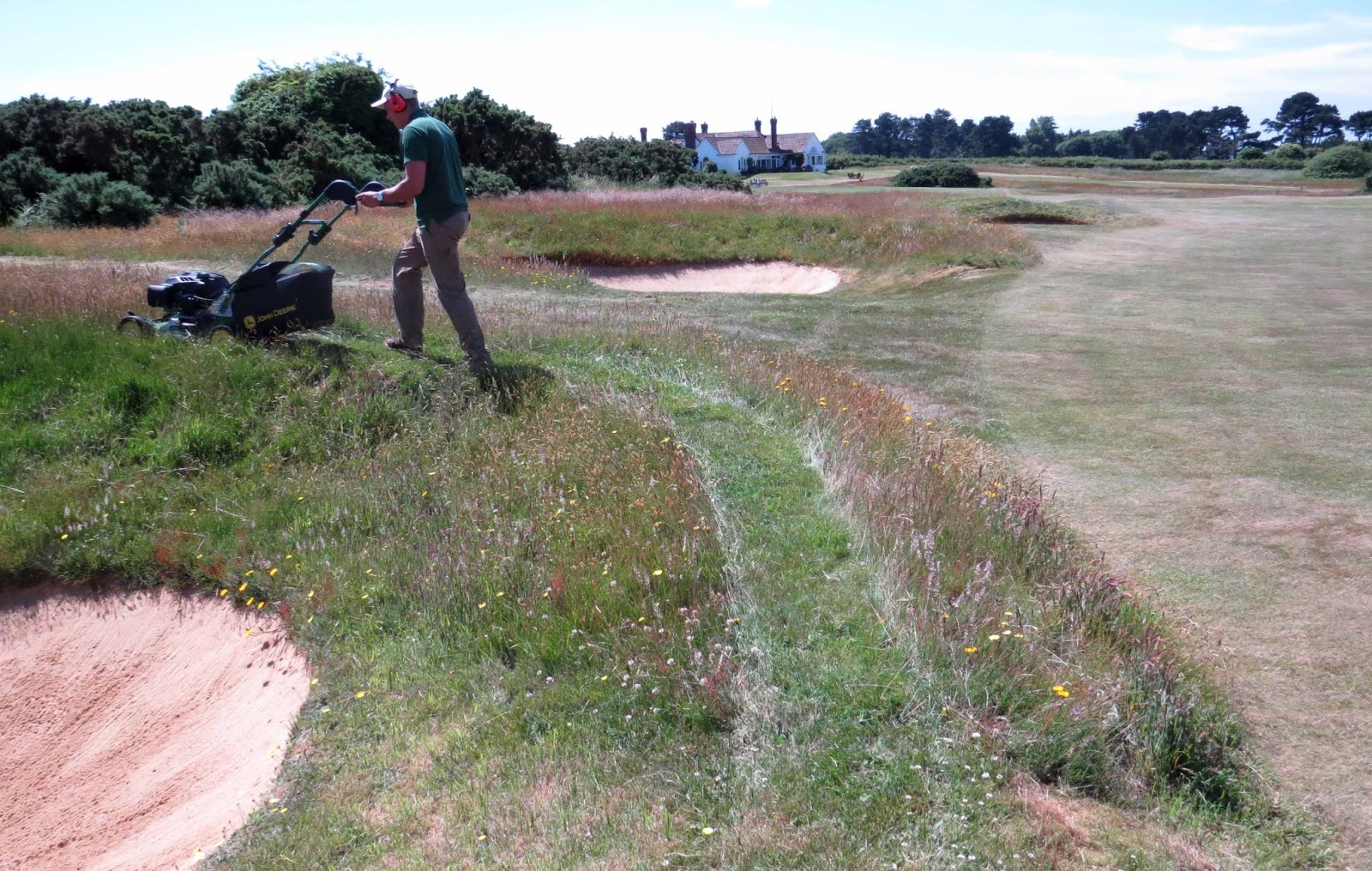 |
| Mowing the bank |
 |
| After mowing |
Monday, 13 June 2016
What's about?
Up to five swans have been seen on the pond on the 7th hole on the river course, one benefit of this is that algae growth that has been problematic for the last few years seams to have been reduced by their activity. The warmer weather has seen reptile activity increase, with several sightings of common lizards and grass snakes.
 |
| Grass snake on the 14th fairway |
 |
| Fox gloves left of the 6th hole |
Course update 13th June
After a week of preparation for the Suffolk Amateur we've started on some renovation work and rough cutting. The lower part of the 4th tee took a bit of a hammering over the winter while we re-built the left hand section. The lower tier has been hollow cored today and we'll top dress and over seed as soon as it stops raining! Rough cutting has also started today, we're concentrating on the most dense areas close to the fairway. This week we will aerate, top dress and over-seed the river course greens and next week it will be the turn of the main course. Fertilizer has been applied to all of the greens today so we can expect a bit of a growth spurt, which should help with recovery from the aeration and top dressing.
 |
| Danny and Trevor hollow coring the 4th tee |
 |
| Neil cutting some dense rough left of the 10th hole |
Subscribe to:
Posts (Atom)