Thursday, 2 June 2016

Course update


The cold dry weather has been limiting growth on the greens over the last few weeks and this has resulted in them looking very patchy as the difference between the fine grasses and the struggling meadow grass is emphasized.  Things are now warming up slowly and the heavy rain on the 31st of May (doubling the monthly total) will give us some growth to work with.

This winter’s very mild and wet winter has given the meadow grass a real boost which is unhelpful as our long term strategy is to minimise the percentage of this weed grass in the greens.  The fine grasses that dominate our greens give us the best chance of providing high quality playing surfaces all year round. We can’t afford to let the meadow grass get too much of a foothold and after this winter it is at historically high levels.  We will therefore be making a big effort to create conditions that favour the fine grasses over the coming months.  This primarily involves putting the weed grasses under mild drought stress, so expect the greens to continue slightly drier and firmer over the summer.

Our overall work programme will be very similar to previous years and as always is based on low inputs of fertiliser and water combined with over-seeding with fine grasses. 

Key elements of the greens maintenance programme include:
  • Maintain a height of cut of 5mm or above unless a slightly lower height is required for major events.  Rest the greens from mowing at least one day per week and more when they are under drought stress and growth is limited.  There is clear evidence to show that as cutting heights are reduced the chances of maintaining fine fescue grasses also reduces.
  •  Use nitrogen only fertilisers from acidifying sources at low rates.  We plan to increase slightly our application levels from previous years to maintain green health under the planned mild drought stress.  Timing of the main fertiliser applications will be from June to the end of July when the fescue grasses are at their strongest. 
  • Keeping the greens as dry as possible without stressing the fine grasses too much.  Irrigation will be applied to maintain a moisture content of circa 10% so that we maximise the time that the greens are under mild drought stress.
  •  Using groomers, brushes, verti-cuts and rollers just enough to maintain surface refinement but no more as any over use favours the meadow grass.
  • Top dressing every four to six weeks to maintain smooth surfaces
  • Regular aeration to maintain a free draining, uncompacted soil which encourages deep rooting and a healthy soil
  • Over-seeding to increase the percentage of fine modern grass cultivars in the greens


Green speed
Our strategy for maintaining all year target green speeds between 8 and 10ft for normal play centres on developing greens dominated by fine grasses that naturally provide higher speed and keeping the greens as dry as possible.  Many of the standard practices for increasing green speed such as lowering the height of cut and increasing the frequency of rolling, brushing and grooming are known to adversely affect the finer grasses – particularly the fescues which dominate at Aldeburgh.  We therefore have less short term ability to influence green conditions than other courses with non fescue greens, our conditions being reliant on excellent long term management techniques.  If we push too hard we will lose out in the long term.  As can be seen in the key elements of greens maintenance section above we are attempting to strike a very fine balance with many aspects of greens maintenance.

Clover
The mild winter gave clover in the fairways a real boost and this spring there was much more than we normally see.  As soon as the weather warmed up enough in May for good growth the fairways were sprayed with selective weed killer.  This has been very effective in knocking back the clover.

Rough
The mild winter has seen the formation of a dense base to much of the long rough contrary to our aim of maintaining wispy rough during the summer which is thin enough for golf balls to be found but challenging to play out of.  We are closely monitoring the position and some areas have already been cut as it was getting too thick. 

Last year the rough remained thin throughout the summer but this year it looks like we’ll have to cut the thickest areas when they get too dense and penal.  When we cut the rough we always remove the cuttings as this helps to thin out the sward by removing nutrients.

Approaches
Our approaches are an area of weakness with too much coarse ryegrass which is unsightly and has a detrimental effect on playing quality.  This year we intend to focus on improving these areas through, over seeding, top dressing, aeration, verti-cutting and use of a selective herbicide called Rescue which controls ryegrass and Yorkshire fog.  We tried this product out on the 17th approach last year and it worked well.  The weed control work will take place in late summer and will result in temporary discolouration and thinning of the turf.

Gorse, bramble and bracken control

Over the last few weeks we have been spot spraying encroaching bramble and gorse.  This work will continue over the summer.  Later in the summer we will continue with bracken control work throughout the course and heathland.  

Wednesday, 4 May 2016

Weather summary for April

What a strange winter it has been.  April temperatures were nearly a degree colder than the long term average at 7.9°, this is nearly 2.5° cooler than December 2015.  The first part of the month was colder than average, with a milder spell mid month and a cold final week or so with several frosts. The highest temperature was a not very impressive 15.9° on the 13th, (last year it was 23.9°) and the lowest was 0.8° on the 1st.  Rainfall was a little higher than average with a total of 40.3mm, 9.6mm of this fell in one day on the 15th.

Tuesday, 26 April 2016

Unseasonable weather

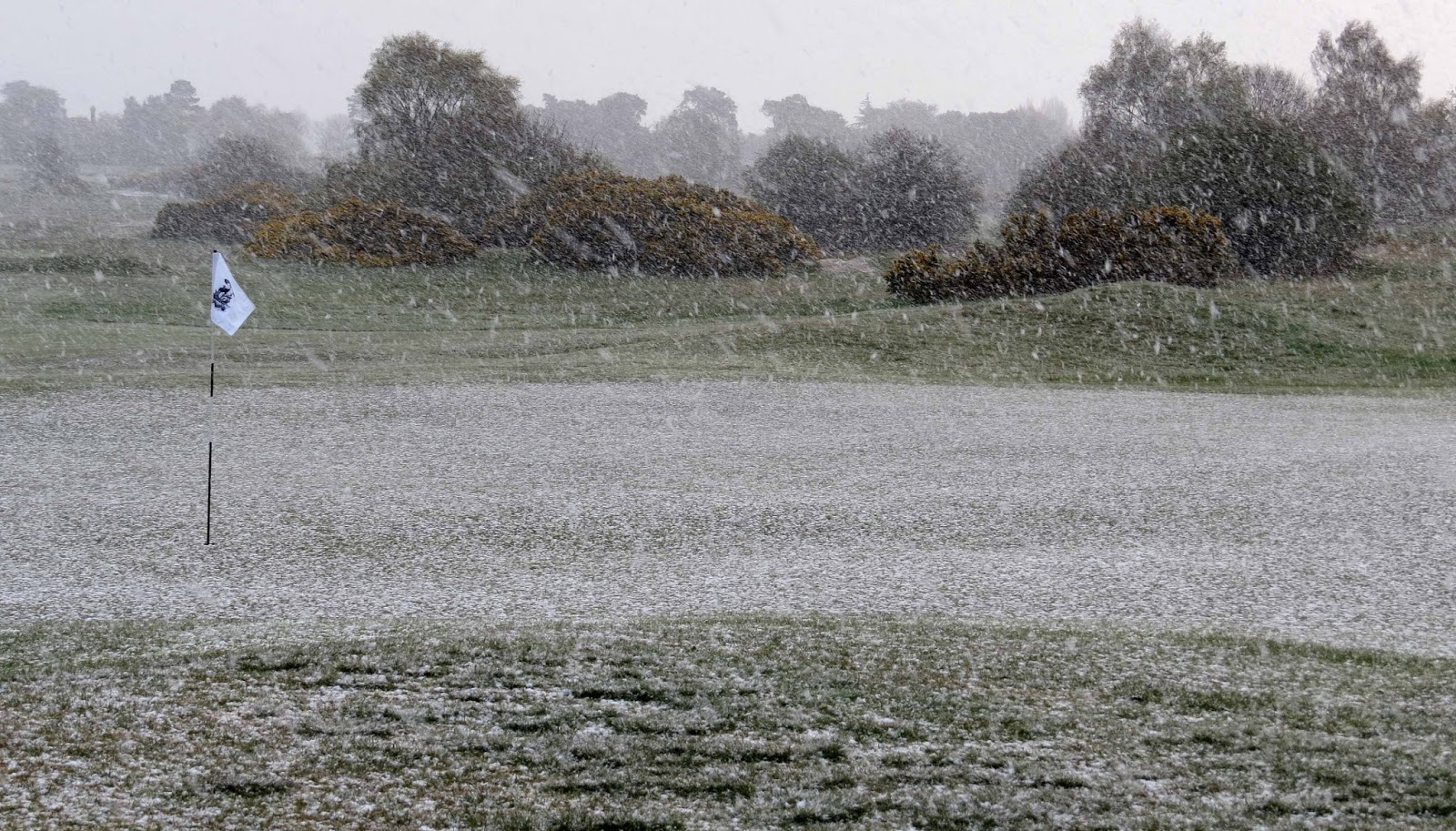
Spring is on hold at present whilst we endure this late cold spell.  This morning we had a series of wintry showers that put a stop to hand mowing the greens, hopefully we'll have better luck tomorrow morning.  The cold weather is likely to remain with us for a few more days but hopefully things will warm up once we get into May and we'll get some much needed grass growth.

The 16th green this morning - mid blizzard

Dawn chorus walk

Last Thursday morning we had a dawn chorus walk led by Steve Piotrowski.  Steve is one of Suffolk's leading experts on birds, he's the author of the Birds of Suffolk, and leads training courses from beginner to advanced level.  On a cool morning we saw and heard a total of 35 species of birds and gained many insights into bird identification by sight and sound.  Nightingales seem to be doing very well on the course, we heard seven singing males and actually managed to get good views of one, which is unusual.  Other highlights were our first cuckoo of the spring and good numbers of linnet.  Steve was impressed by the work we've done on heathland and scrub management as this has enhanced the site as a habitat for birds and other wildlife.

The nightingales will be singing on the course for the next few weeks, for those of you who are not sure what a nightingale sounds like, here's a link to the nightingale pages of the xeno-canto website.
Nightingale song  xeno-canto is an excellent resource for anyone interested in birds - there are thousands of recordings of a very wide range of bird songs and calls.


Steve Piotrowski's bird track record of species and numbers of birds seen on the walk

Monday, 11 April 2016

Renovation of approaches

We've been renovating the approaches over the last week as part of our programme of work to improve these areas.  There is a lot of coarse and weed grass in the four or five metres in front of many greens and our aim is to fine these down and introduce more fine grasses.  This week we have hollow cored, followed by top dressing and over-seeding with fine fescue.

Antony hollow coring on the 15th

Thursday, 7 April 2016

Top dressing greens

We've top dressed the greens this week, top dressing is an essential part of our greens maintenance programme which improves putting surfaces and benefits turf health.  Top dressing gives us smoother, truer, faster, firmer and more consistent greens.  It promotes upright growth and a tighter more fine textured sward.

Regular top dressing also helps us to control the level of organic matter in the soil by diluting it and creating conditions conducive to organic matter breakdown.  This is important because if organic matter levels build up we get soft, thatchy surfaces, reduced playing quality and plant health issues such as disease, water retention and impeded drainage.   Our target range for organic matter levels in the greens' root-zone  is 4% to 6% and we're currently at 7% to 8%.

We've been using Fendress, a mixture of sand and fen soil to top dress the greens since 1989. Continuity is important with top top dressing to prevent layering in the soil profile which causes a number of problems such as root breaks and impeded drainage.

We aim to put about 100 tonnes per year of top dressing on the main course greens, usually in six applications spaced four to six weeks apart.  The actual rate on the day varies from half a tonne per green to a tonne per green depending on factors such as grass growth rate, weather conditions, fixtures and whether we have done renovation work such as aeration or over-seeding.

Timing of top dressing application depends on a number of factors.  Firstly grass growth is required so that the material can be incorporated into the base of the sward.  Weather conditions play a big part as we can't top dress effectively if it is raining or the greens are wet.  The timing of the programme is also affected by major golf events and other fixtures, we would not normally top dress during the three weeks before a major event.

After top dressing we rarely cut the next day and for a few days we use an old mower to prevent the blades of our best mower from being blunted by the sand.

Jerry top dressing the 15th green


Wednesday, 6 April 2016

Weather summary for March

 The average temperature for the month was 6.64° which is slightly warmer than average but as is often the case the average hides some big fluctuations in temperature.  The first couple of weeks of the month were very cold and this was actually the coldest spell of the winter, the weather then turned much milder.  March was only half a degree warmer than January and just over half a degree warmer than February.  The highest temperature was 13.7° on the 25th and the lowest  -0.6° on the 16th.  There was 43.8mm of rainfall which is about 7mm more than average.

Saturday, 26 March 2016

Is it spring yet?

We've passed the vernal equinox so spring is officially here but there's no sign of any grass growth.  There are some signs that spring is on its way, with birds that winter in warmer climes starting to arrive.  Our first Chiffchaffs of the season started singing this week and a common lizard was seen on the course.  Blackcaps will turn up soon but we'll probably have to wait until mid April for the Nightingales to start singing.  Nightingales have been amazingly consistent in their arrival date on the course, with very few exceptions we've first heard them singing on the 14th of April.

Common Lizard
(Usually too quick to photograph but it was a cool day so this one was a little sluggish)

Bank Vole (Watering forest near the maintenance buildings)

Thursday, 10 March 2016

Transplanting gorse

We've transplanted well established gorse plants into the area left of the 18th green that was previously covered with bramble.  When these grow, they will provide an evergreen screen between the 18th green and the maintenance area and access track.  Two sycamore trees were also removed to reduce shade and increase air movement on the 18th green.


Wednesday, 2 March 2016

Weather summary for February

This winter has been extremely mild and although February was about a degree warmer than average at 5.9° this is much closer to normal than the record breaking extremes we had earlier in the winter.  The highest temperature was 14.9° on the 21st and the lowest  -1.3° on the 16th.  There was 21.2mm of rainfall which is much lower than the 36.6mm average for the month.